Données Diverses
,
Diagnostic
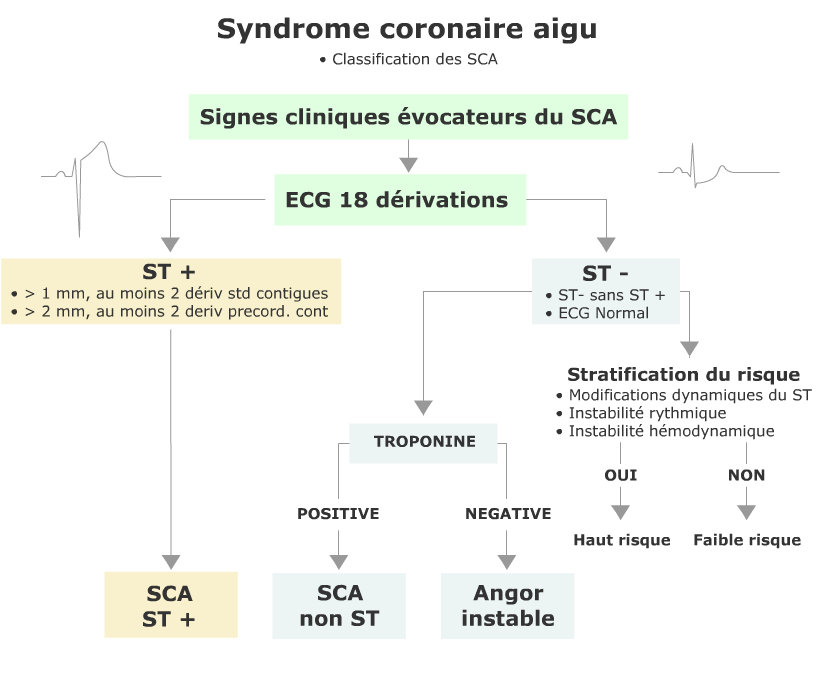
Clinique & ECG
– Douleur angineuse continue et récente (plus de 15 minutes)
– ECG :
- Sus décalage de ST dans 2 dérivations adjacentes > 0.1mV dans les standards > 0.2mV dans les précordiales
- images en miroir
- Sous décalage de ST dans 2 dérivations adjacentes
- ECG normal
–>
– douleur trinitro-résistante
consultez le simulateur ECG

Importance de l’anamnèse
– ATCD personnels, terrain, facteurs de risque cardiovasculaire, circonstances de survenue
– Rechercher un diabète, une insuffisance rénale (facteurs de gravité).
Diagnostics différentiels
– péricardite, myocardite, dissection aortique, embolie pulmonaire, intoxication digitalique, intoxication au CO…
BILAN PARACLINIQUE
Bilan de routine
– ECG 18 dérivations (à renouveler) – Glycémie capillaire – Monitorage Scope, PNI, SpO2
Bilan spécifique
– Hémostase (Groupe, NFS, plaquettes, TP, TCA) – Myoglobine + Troponine (en cas de ST+ ne pas attendre les résultats pour entreprendre la recanalisation d’urgence).
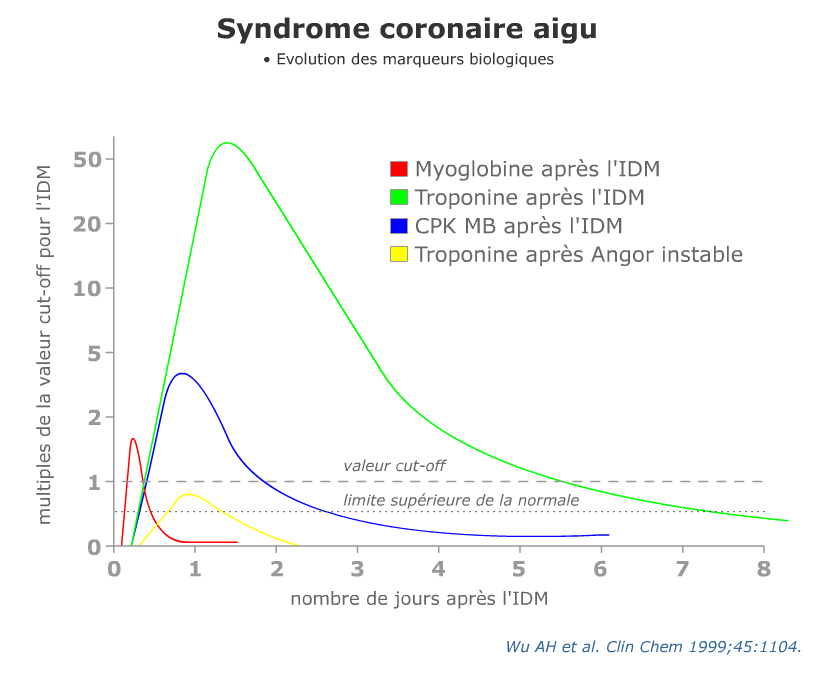
La troponine s’élève entre la quatrième et la sixième heure. Répéter le prélèvement +++
Interprétation des résultats de la Troponine T ultra sensible
– TnTc HS <0,014 ng/mL :
- et douleur thoracique > 3h
- sortie avec discussion des explorations ambulatoires à 30 jours
–>
–>
- et douleur thoracique < 3h
- répéter le dosage 3 heures après le premier prélèvement
- augmentation <0,007 ng/mL ou <30%, sortie avec discussion des explorations ambulatoires à 30 jours
- augmentation >0,007 ng/mL ou >30%, discuter avec le cardiologue de l’admission pour explorations.
–>
–>
- répéter le dosage 3 heures après le premier prélèvement
–>
– TnTc HS 0,014-0,05 ng/L :
- répéter le dosage 3 heures après le premier prélèvement
- augmentation <0,007 ng/mL ou <30%, sortie avec discussion des explorations ambulatoires à 30 jours
- augmentation >0,007 ng/mL ou >30%, discuter avec le cardiologue de l’admission pour explorations.
–>
–>
– TnTc HS >0,05 ng/mL :
- discuter avec le cardiologue de l’admission pour explorations.
–>
Classification des SCA
TRAITEMENT
Thérapeutique symptomatique
– Test aux dérivés nitrés. L’usage intra veineux est limité aux SCA non ST (en respectant les contre indications) et en surveillant étroitement la PA la fonction ventriculaire droite. – Morphine titrée (en fonction de l’EVS) , anxiolytiques éventuels. – 2 voies veineuses (G5% et Nacl) en garde veine. – O2 si spo2 < 93% ou Killip > 1
Thérapeutique spécifique
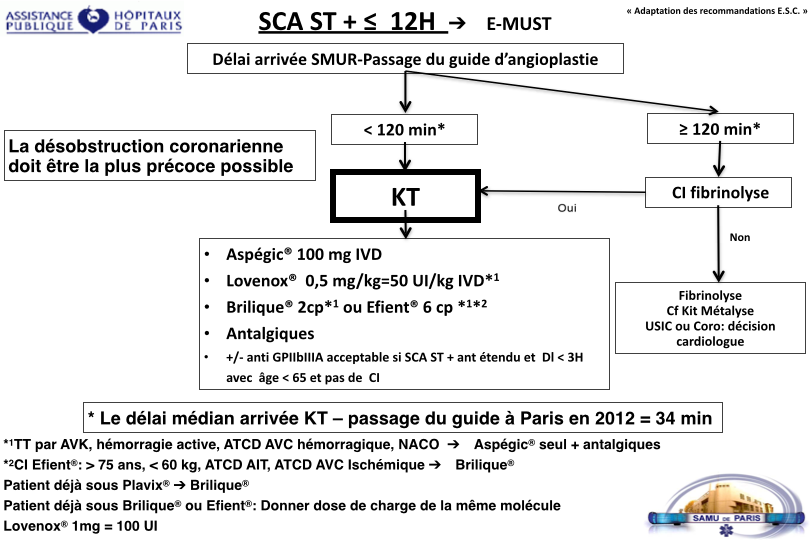
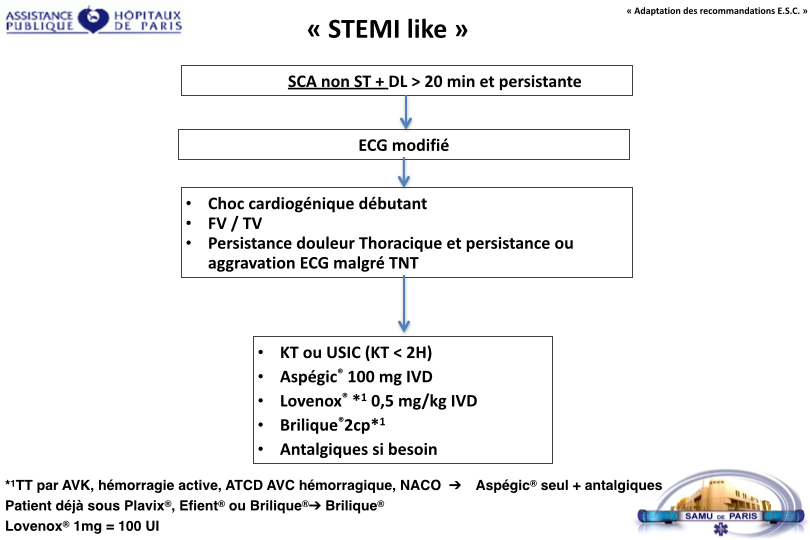
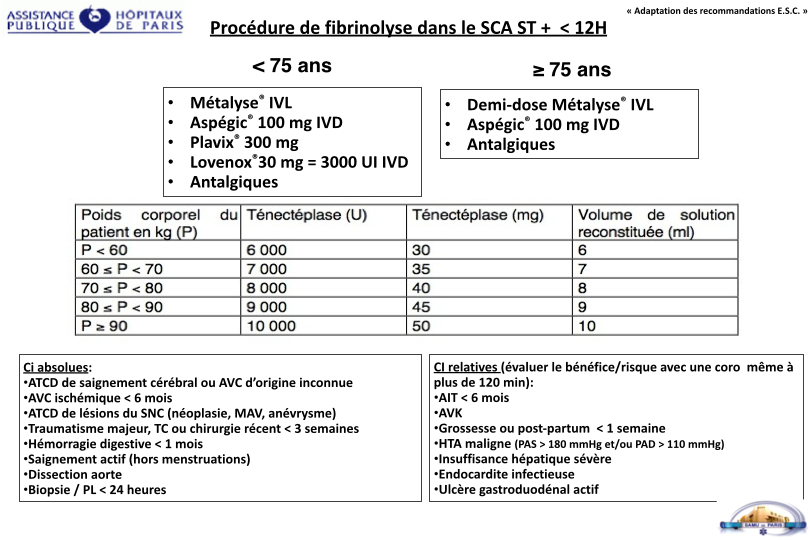
Protocole officiel du SAMU de PARIS, SMUR Necker, SMUR Hôtel Dieu, SMUR Lariboisiere, SMUR Pitié.

Rappels de pharmacologie :
| Nom | Classe | Action | Administration |
|---|---|---|---|
| Clopidogrel (Plavix®) | anti-adhésif et anti-agrégant plaquettaire de la classe des thiénopyridines antagoniste irréversible du récepteur P2Y à l’ADP, ce qui empêche l’activation du complexe GPIIb-IIIa. |
Délai d’action : 2h Pic : 6h Durée d’action : 7-10 jours (durée de vie des plaquettes) |
per os |
| Ticagrelor (Brilique®) | anti-adhésif et anti-agrégant plaquettaire de la classe des cyclopentyltriazolopyrimidines antagoniste sélectif et réversible du P2Y, n’agissant pas au site d’action de l’ADP, mais empêchant la transduction du signal. |
Délai d’action : < 30 min Pic : 2-4h Durée d’action : 4 jours |
per os |
| Prasugrel (Efient®) | anti-adhésif et anti-agrégant plaquettaire de la classe des thiénopyridines antagoniste irréversible du récepteur P2Y à l’ADP, ce qui empêche l’activation du complexe GPIIb-IIIa. |
Délai d’action : < 30 min Pic : 4h Durée d’action : 7-10 jours (durée de vie des plaquettes) |
per os |

pdf »>
pdf »> pdf »> Score de risque = Total des points (0-7) –
Classification ESC –
Calculateurs de risque –
Acute coronary syndromes, Scottish Intercollegiate Guidelines Network – SIGN (Feb 2013) –
Steg G, James S et al. ESC Guidelines for the management of acute myocardial infarction in patients presenting with ST-segment elevation European Heart Journal (2012) 33, 2569&2619 –
Scheuermeyer FX, Innes G, Grafstein E, et al. Safety and Efficiency of a Chest Pain Diagnostic Algorithm With Selective Outpatient Stress Testing for Emergency Department Patients With Potential Ischemic Chest Pain. Ann Emerg Med. Jan 4 2012 ; –
Hamm CW, Bassand JP, Agewall S, et al. ESC Guidelines for the management of acute coronary syndromes in patients presenting without persistent ST-segment elevation : The Task Force for the management of acute coronary syndromes (ACS) in patients presenting without persistent ST-segment elevation of the European Society of Cardiology (ESC). Eur Heart J. Sep 21 2011 –
Hyperglycaemia in acute coronary syndromes, NICE Clinical Guideline (October 2011) –
Acute coronary syndromes – ticagrelor, NICE Technology Appraisal Guideline (October 2011) –
Heidenreich PA, Alloggiamento T, Melsop K, McDonald KM, Go AS, Hlatky MA. The prognostic value of troponin in patients with non-ST elevation acute coronary syndromes : a meta-analysis. J Am Coll Cardiol. Aug 2001 ;38(2):478-85. –
O’Connor RE, Bossaert L, Arntz HR, Brooks SC, Diercks D, Feitosa-Filho G, et al. Part 9 : acute coronary syndromes : 2010 International Consensus on Cardiopulmonary Resuscitation and Emergency Cardiovascular Care Science With Treatment Recommendations. Circulation. Oct 19 2010 ;122(16 Suppl 2):S422-65. –
Heidenreich PA, Alloggiamento T, Melsop K, McDonald KM, Go AS, Hlatky MA. The prognostic value of troponin in patients with non-ST elevation acute coronary syndromes : a meta-analysis. J Am Coll Cardiol. Aug 2001 ;38(2):478-85. –
Chest pain of recent onset, NICE Clinical Guideline (March 2010) –
Unstable angina and NSTEMI, NICE Clinical Guideline (March 2010) –
Swanson N, Montalescot G, Eagle KA, et al ; Delay to angiography and outcomes following presentation with high-risk, Heart. 2009 Mar ;95(3):211-5. Epub 2008 Sep 18. –
Acute coronary syndrome – prasugrel, NICE Technology Appraisal Guideline (October 2009) –
Peters RJ, Mehta S, Yusuf S ; Acute coronary syndromes without ST segment elevation. BMJ. 2007 Jun 16 ;334(7606):1265-9. –
Cohen M, Diez JE, Levine GN, et al ; Pharmacoinvasive management of acute coronary syndrome : incorporating the 2007 ACC/AHA guidelines : the CATH (cardiac catheterization and antithrombotic therapy in the hospital) Clinical Consensus Panel Report—III. J Invasive Cardiol. 2007 Dec ;19(12):525-38 ; quiz 539-40. –
Conway Morris A, Caesar D, Gray S, et al ; TIMI risk score accurately risk stratifies patients with undifferentiated chest pain presenting to an emergency department. Heart. 2006 Sep ;92(9):1333-4. –
Sabatine MS, Morrow DA, Giugliano RP, et al ; Implications of upstream glycoprotein IIb/IIIa inhibition and coronary artery stenting in the invasive management of unstable angina/non-ST-elevation myocardial infarction : a comparison of the Thrombolysis In Myocardial Infarction (TIMI) IIIB trial and the Treat angina with Aggrastat and determine Cost of Therapy with Invasive or Conservative Strategy (TACTICS)-TIMI 18 trial. Circulation. 2004 Feb 24 ;109(7):874-80. Epub 2004 Feb 2. –
Lagerqvist B, Husted S, Kontny F, et al ; A long-term perspective on the protective effects of an early invasive strategy in unstable coronary artery disease : two-year follow-up of the FRISC-II invasive study. J Am Coll Cardiol. 2002 Dec 4 ;40(11):1902-14. –
Culic V, Eterovic D, Miric D, et al ; Symptom presentation of acute myocardial infarction : influence of sex, age, and risk factors. Am Heart J. 2002 Dec ;144(6):1012-7. –
Alpert JS, Thygesen K, Antman E, Bassand JP. Myocardial infarction redefined—a consensus document of The Joint European Society of Cardiology/American College of Cardiology Committee for the redefinition of myocardial infarction. J Am Coll Cardiol. Sep 2000 ;36(3):959-69. –
Antman EM, Tanasijevic MJ, Thompson B, Schactman M, McCabe CH, Cannon CP, et al. Cardiac-specific troponin I levels to predict the risk of mortality in patients with acute coronary syndromes. N Engl J Med. Oct 31 1996 ;335(18):1342-9. –
Heidenreich PA, Alloggiamento T, Melsop K, McDonald KM, Go AS, Hlatky MA. The prognostic value of troponin in patients with non-ST elevation acute coronary syndromes : a meta-analysis. J Am Coll Cardiol. Aug 2001 ;38(2):478-85. –
GRACE ; Global Registry of Acute Cardiac Events –
The TIMI Study Group
TIMI Score Risk pour le SCA non ST
— Facteur de risque —
— Points —
— Mortalité à J 14 —
à‚ge >= 65 ans
1
5%
> 3 facteurs de risque coronaire
1
8%
Cardiopathie ischémique reconnue
1
13%
prise d’aspirine au cours des 7 derniers jours
1
20%
Douleur angineuse récente
1
26%
Augmentation des enzymes
1
41%
Sous décalage de ST > 0,5 mm
1
–
Patient à haut risque
Patients à faible risque
douleurs thoraciques récidivantes et/ou modifications dynamiques du ST
pas de douleur thoracique au cours de la période d’observation
modifications du segment ST non interprétables
ST normal mais T<0 ou plates
élévation du taux de troponine
troponine normale
instabilité hémodynamique
arythmies majeures TV/FV
diabète type 1
angor instable précoce après IDM
Références